
In CrossFit, Hyrox, and other functional sports, along with Olympic weightlifting, there are many events that require real skill. So how should we go about practicing those skills?
Just like we train muscle and endurance, we also need to train our skill capacity. But some people interpret that as “just practice a lot.” I used to think the same way.
CrossFit movements involve all kinds of skills. Early on, I would just do my weak movements every day, or work them into my workouts as a form of practice. Looking back, I clearly remember that my skills barely improved during that period.
For example, there is a movement in Olympic weightlifting called the snatch, where you take the barbell from the floor to overhead in one motion. I was terrible at it. So I just did it every day. Even when I trained at a regular gym without proper lifting platforms, I used a barbell that wasn’t meant for lifting.
The result was pain in my lower back and shoulders, and I ended up learning bad form, which meant the movement never really worked properly.
Doing high volume really does matter. There’s a saying, “quality over quantity,” but I actually think quality shows up within quantity. Without putting in the reps, you can’t judge for yourself whether the quality is good. So volume matters.
That said, mindlessly grinding out reps isn’t a great approach either. I hurt myself doing that, and I don’t think technical improvement comes just from blindly doing more. You need volume that has intention behind it.
With that in mind, let’s think about how we should actually be training.
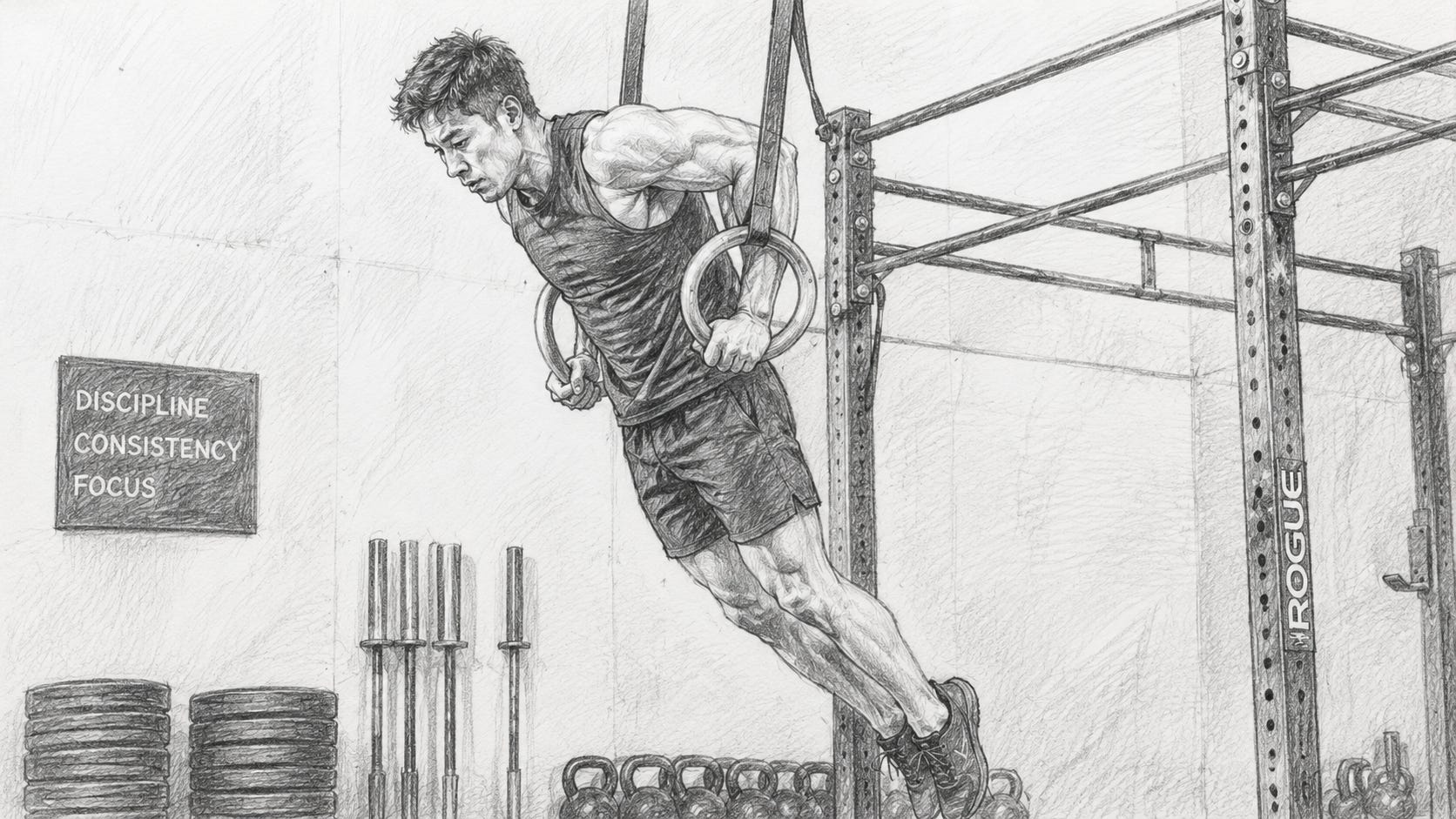
The Solution
Assuming volume training is a given, here are four points I think matter most.
Know the Movement
It’s more efficient to work on mobility and strength deficits separately. Trying to practice a movement without understanding this tends to be a detour. When you’re aiming for a specific movement, you often can’t do it because you’re lacking either strength or mobility.
Let’s look at a concrete example.
I spent a long time trying to learn the kipping bar muscle up. For at least six months, I set aside time to practice it about twice a week, but I couldn’t get it. One day, a friend at my gym landed his first rep and I asked him what the secret was. He said it suddenly clicked once he could do ten strict pull ups from a dead hang. Hearing that, I increased my back training frequency for a while and worked up to ten pull ups. Sure enough, just like my friend, I was suddenly able to do the kipping bar muscle up, even though I had actually reduced how much I practiced the kipping movement itself during that time.
What I learned from that experience is that if you don’t take care of the prerequisites first, the time you spend on the skill itself can go to waste. If the prerequisites aren’t there yet, focus on those first, then gradually move into practicing the actual skill.
This example focused on strength, but mobility matters just as much. Say you want to hit a full depth squat. You want your hips to drop below your knees, but you just can’t get there. One option is to squat as deep as you can every time, which does function as a mobility drill of sorts, but it isn’t very efficient. In practice, doing separate mobility work for the spine, hips, and ankles tends to get you results faster.
Practice the Actual Movement Frequently
Once the prerequisites are covered, the next step is doing the movement often. As with anything, skill acquisition comes down to frequency. Volume matters too, of course, but if I had to choose between volume and frequency, I’d say frequency wins.
That’s because learning a skill requires rewiring in the brain to support that movement. This happens partly while you’re practicing, but it happens even more during sleep. Your body isn’t actually moving while you sleep, but your brain replays what you did that day, and does so far more times than you actually performed the movement while awake. Since you want as many of those replays as possible, you want to keep the frequency consistent.
What matters here is the volume of each individual session. If frequency is the priority, pushing yourself to failure in a single session isn’t a great strategy. You’ll end up too fatigued, and even if you try to keep the frequency up, the quality of your next session may suffer. The goal is the right volume at the right frequency.
Incorporate Partial Practice
Rather than always practicing the full movement, breaking it down into parts and practicing those separately is also very effective. It lets you focus specifically on the part you struggle with, which sharpens your feel for it and improves the movement overall. Even when you practice in parts, your brain blends that feel back into the full sequence, which carries over and makes you better at the whole movement.
Personally, I think skipping partial practice is a missed opportunity. When you only practice the full sequence, you end up burning energy on the parts you’re already good at, which leaves less total volume for the part you actually need work on. Partial practice lets you direct your time and energy specifically at your weak point, which is exactly why it works.
Going back to the snatch example from earlier, the movement ends in the bottom position of an overhead squat. If that specific position is what you struggle with, it’s worth isolating and practicing on its own. You could simply practice overhead squats, or pair it with snatch balances, or combine it with other weak points you’re working on. Practicing this way is what eventually refines the full snatch as one smooth sequence.
Correct and Improve
Reviewing your training is essential. That could mean writing down what you noticed and felt in a notebook, or filming yourself and breaking down what went wrong. As you train, thinking through what went wrong in the last rep, and what needs to change, and applying that to the next attempt, session after session, matters a great deal.
Earlier I said that doing high volume matters, but volume alone isn’t enough. Within that volume, each attempt needs some reflection and a small adjustment you can apply to the next one. Making these small corrections over and over is how you build the movement pattern and feel that work best for you. A lot of people try to fully verbalize how a movement should feel, but that approach doesn’t work for everything. Sometimes a feeling is enough to understand through imagery alone, something like “that squeeze feeling,” whatever phrase clicks best for you. Using cues like that to sharpen your training works just as well.
Sho